From Vaudeville Bill to Variety Television
From vaudeville bill to variety television, learn how hosts, camera framing and transitions made mixed acts feel like one coherent programme.
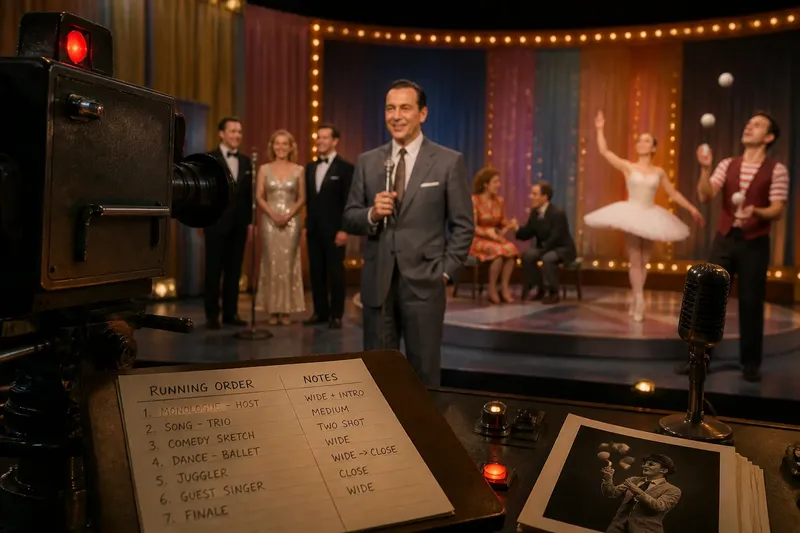
From vaudeville bill to variety television, the central challenge was making unrelated acts feel like one programme. A stage audience saw a shared space; a television viewer saw only the camera’s chosen frame, so the host, running order and transitions had to create a different kind of continuity.
Variety television reshaped the mixed bill
Vaudeville bills brought together performers with distinct skills and no continuing plot. A singer, comic turn and dancer could follow one another because the audience understood the arrangement: each act was a separate event within the same evening. Television kept that variety but presented it through a sequence of shots and pauses, rather than a single view of the stage.
That distinction is visible in familiar American examples. The Ed Sullivan Show, which began in 1948, placed performers from different fields within a recurring Sunday-night programme hosted by Sullivan. The Carol Burnett Show, which began in 1967, combined sketches, songs and recurring characters, using its ensemble and comic frame to connect varied material. These programmes did not make vaudeville and television identical; they show different ways television could organise a mixed bill for the screen.
A host gives separate acts a shared frame
On stage, a compère could respond to the room and bridge a change with patter. On television, a host could provide a recurring presence, introduce a performer and give viewers a reason to stay with the programme between acts. The introduction did not need to explain everything. A concise detail about what to watch or why an act was unusual could orient the viewer without delaying the performance.
Hosts also helped establish tone. Sullivan’s formal introductions suited the variety of performers gathered on his show, while Burnett’s comic persona and ensemble helped make sketches and songs part of a recognisable comic programme. These are different approaches, not a universal formula: a programme’s framing works best when it fits its performers and material.
Television transitions need a visible purpose
A curtain, blackout or musical interlude could cover a stage change. Television had its own options: cut to the host, hold on a useful detail, use a brief musical cue or show the next performer preparing. Each choice affected what the viewer experienced during the reset.
An empty stage or an unexplained pause could make the interval feel like dead air. Yet a cut should not hide information the audience needs. If a prop is central to the next act, a glimpse of it can build recognition; if a set is being moved, the host can bridge the moment with a short introduction. The transition becomes part of the programme when viewers can follow its purpose.
Camera framing should preserve the act’s essential business
Different performances depend on different kinds of attention. A singer may communicate through facial expression, a dancer needs room for movement, and a physical comedian may rely on a prop and the audience seeing its path. A close-up can reveal a reaction but crop a gesture; a wide shot can show movement while making an expression harder to read.
Say a fictional variety programme books a juggler whose routine ends with a deliberately missed catch. The director first lists the essential action: the performer’s hands, the prop’s fall and the landing area. They choose a wide frame for the missed catch, then cut closer to the performer’s reaction after the prop lands. The result keeps the cause of the joke visible while still giving the reaction its moment.
Act order shapes the viewer’s attention
A running order can feel monotonous even when each act is strong, if every turn asks for the same kind of attention. Several talk-heavy performances may blur together; a succession of loud, fast acts may leave little room for contrast. Television makes sequence especially apparent because viewers encounter one selected performance after another.
One way to plan an order is to note what each act asks viewers to notice: words, musical detail, full-body movement, visual surprise or a character exchange. A quiet song after a physical comedy turn changes the texture; a sketch after a solo singer shifts the programme from one performer’s presence to a group scene. These are editorial choices, not a fixed recipe. The order should suit the material and the practical demands of changing sets and camera positions.
What readers ask about vaudeville and variety television?
Why did television variety shows use a host?
A host gave viewers a familiar presence between acts and could make transitions intelligible. The role also allowed a brief introduction to supply context without turning every performance into part of a continuous story.
How did television change the order of variety acts?
Television made visual contrast and camera requirements part of the running-order decision. Producers could consider mood, performance style, framing and set changes alongside the variety of skills on the bill.
What made a variety act work on camera?
The camera needed to show the detail the act depended on, such as a facial reaction, a full-body movement or a prop’s path. Framing and cuts served the performance when they made that detail legible rather than obscuring it.
Did television replace the vaudeville format?
Television adapted rather than simply copied the mixed bill. Programmes retained distinct acts but used hosts, editing, camera choices and recurring settings to connect them for viewers at home.
Programme continuity comes from arrangement
Variety television did not need to make every performer sound alike or fit a single plot. Its continuity came from the frame around the acts: a host’s presence, a considered order, a transition that made sense and a camera view that respected each performance’s needs.
For anyone tracing the route from vaudeville bill to variety television, the useful distinction is between the acts and the arrangement. The acts could remain strikingly different; the programme’s work was to make their succession feel deliberate, one introduction and one carefully chosen view at a time.